![Modulr_Logo_Black_LightOrange-1.png]](https://knowledge.modulrfinance.com/hs-fs/hubfs/Modulr_Logo_Black_LightOrange-1.png?height=40&name=Modulr_Logo_Black_LightOrange-1.png)
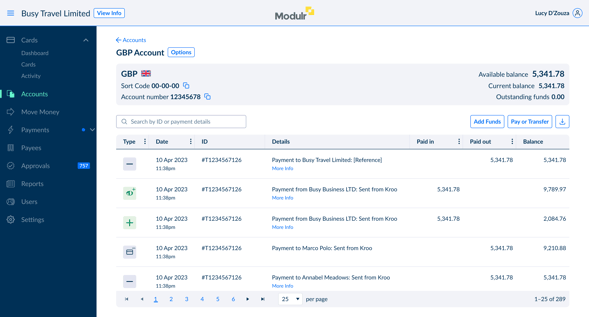
Viewing an account
- Select Accounts in the side menu. This shows every account you have access to.
- Select the account you want to open.
- To return to the full list at any time, select ← Accounts at the top of the screen, or Accounts in the side menu.
If you use a Delegate, Partner or multi-customer portal, choose the customer first; the Accounts menu then lists the accounts available under that customer.
The account header
The header sits at the top of every account view and holds the details you reach for most often.
Account name and Options
The account name (its alias) appears as the title. Next to it, the Options button opens account-level actions and settings for that account. The exact items depend on your permissions.
Balances
Three balances are shown on the right of the header:
- Available balance: the funds you can use right now.
- Current balance: your total balance, including amounts still being processed.
- Outstanding funds: amounts needed for all payments Awaiting Funds to execute
Sort code and account number
Your sort code and account number are shown beneath the account name. Euro accounts display a BIC and IBAN in the same place.
The transactions list
Every transaction for the account appears in the table below the header. Column with ‘…’ in the header can be filtered (see Filtering).
| Column | What it shows |
|---|---|
| Type | An icon indicating the kind of transaction — money in, money out, card payment, reversal, and so on. |
| Date | The date and time of the transaction. |
| ID | The transaction’s unique reference. |
| Details | The payee or payer, the payment reference, and a More Info link to the full detail. |
| Paid in | The amount received, where the transaction is money in. |
| Paid out | The amount sent, where the transaction is money out. |
| Balance | The account balance immediately after that transaction. |
Use the pager at the foot of the table to move between pages and to set how many transactions appear per page. The page also shows your position in the list, for example “1–25 of 289”.
Searching transactions
Use the Search by payment details box above the table to find a transaction quickly.
- Type a part of the reference.
- Press Enter to see results
- Clear the search box to return to the full list.
Filtering columns
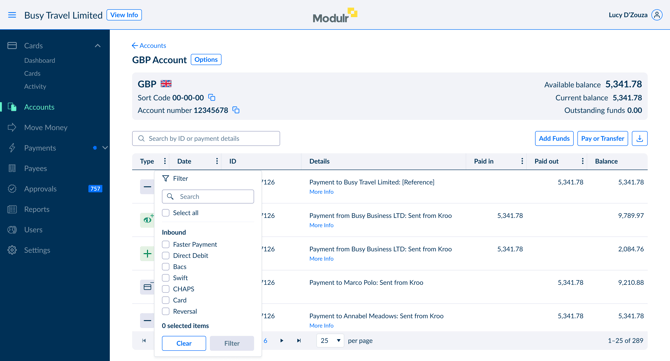
Each column header has a menu (the three-dots icon) for filtering that column. This replaces the single search panel used previously and lets you narrow the list one column at a time.
Open a column menu to:
- Filter: show only the rows you want.
The Type column filter groups payment methods so you can isolate, say, only card payments or only inbound Faster Payments:
- Inbound: Faster Payment, Direct Debit, Bacs, Swift, CHAPS, Card, Reversal, Internal.
- Outbound: Faster Payment, Direct Debit, Swift, CHAPS, Internal, Reversal, Card.
To apply a filter:
- Open the column menu and tick the options you want. Use Select all to choose every option, and the search box to find one quickly.
- Select Filter to apply. The count of chosen options is shown (for example, “0 selected items”).
- Select Clear to remove the filter.
Viewing a transaction’s details
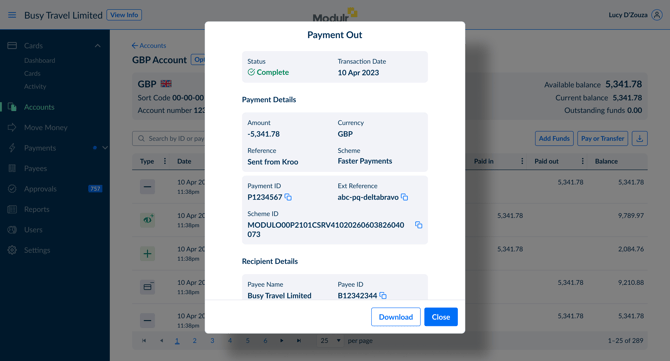
Select More Info on any transaction row to open its full detail.
For a standard payment, the panel shows:
- Status and Transaction Date.
- Payment Details: Amount, Currency, Reference, Scheme, Payment ID, Ext Reference and Scheme ID. Use the copy icon to copy any value.
- Sender Details (for money in) or Recipient Details (for money out) — the name, sort code and account number of the other party.
Select Close to return to the list.
Card payments and the card behind them
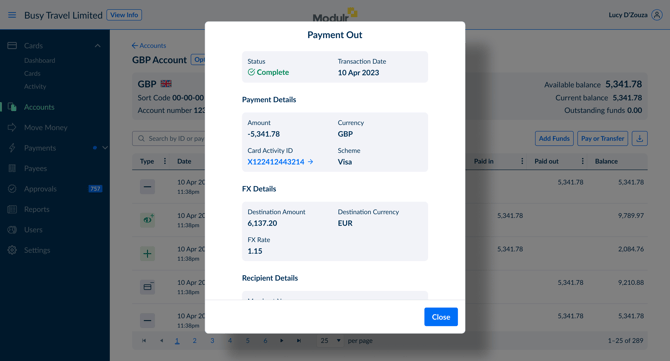
When a transaction is a card payment, its More Info panel links straight through to the card that made it.
The panel shows the usual Payment Details, plus:
- A Card Activity ID: the reference for this specific card movement.
- FX Details: shown when the card payment is in a currency other than the account’s. It gives the Destination Amount, Destination Currency and FX Rate. This conversion is handled by the card scheme, so it appears automatically; no separate FX step is involved.
- Recipient Details: Merchant Name, Merchant ID and MCC.
- Card Details: the Card ID, Alias, Limit, Usage (for example, Single-use), and a Show Custom Fields link.
Select the Card ID (or Card Activity ID) to open that card’s details screen. The transaction ID is carried across automatically: the card’s Activity tab opens pre-filtered to the matching item, so you land directly on the settlement or refund responsible for the account transaction. No need to search the card’s activity yourself.
On the card details screen you can see the card’s status, PAN, expiry, limit, currency and authorisation window, switch between the Activity and Links tabs, and adjust the Filter type or search to widen the view. Select ← Account Transactions to return to where you started.
Exporting transactions
Select the download icon, to the right of the toolbar, to export the account’s transactions as an Excel (.xlsx) file, useful for your records or reconciliation.
When there’s nothing to show
The screen adapts to what’s happening, so it’s always clear whether the account is simply new, your search was too narrow, or something has gone wrong.
- No transactions yet: a “No transactions to display” message appears, with the note that “Transactions from 6 months appear here” and a Learn more link. You’ll see this on a new account, or one with no recent activity.
- No search results: if a search or filter returns nothing, you’ll see “No results” and a prompt to “Try using different search terms or filters.” Adjust or clear your search to see the full list again.
- Something went wrong: if the transactions can’t load, you’ll see “We’re having trouble showing this content.” Select Try Again. If the problem continues, try again later.
Related guides
The account view is also your starting point for moving money:
- Add Funds: top up this account.
- Pay or Transfer: make a payment or move money between accounts.
To be alerted to account activity such as balance changes or incoming funds, set up alerts under Notifications in the side menu.
